Castillian Spanish?
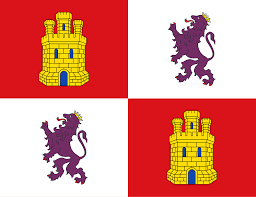
The flag of Castilla y León
I’ve studied and lived in Latin America, so why teach Castillian Spanish rather than anything else?
What is Castillian Spanish (castellano)?
Historically, Castilla referred to the north and centre of Spain. The language which we now refer to as castillian was first recorded in the 11th century, perhaps earlier, and the Castilla area was politically one of the strongest and wealthiest. It’s borders, like every region in Spain, have changed over the years.
Today Castilla and León is the largest of the 17 autonomous Spanish communities.
We’ll look in future blogs at each of these regions, many of which have their own languages or dialects (including other languages are also spoken in Spain, including Catalan/Valencian, Galician, Basque). It’s obligatory for each community (comunidad) to offer services in castellano, so, politically at least, the language is seen as a unifying force.
As we’ll see in future blogs, each region feels differently about both the language and about its role in ‘Spain’.
Universidad de Salamanca (Salamanca University)
Salamanca’s role cannot be ignored: its university was founded in 1218 by King (Rey) Alfonso IX of Leon. It is the oldest university in the Hispanic world. It’s also the fourth oldest University in the world in continuous operation. (Thank you Wikipedia for helping me out with that little snippet.)
Every year more than 25 thousand students head to Salamanca to learn, perfect and practise their Spanish. If you want a Diploma español, an official state approved Spanish diploma, Salamance is the only place to go!
Why? Salamanca’s accent is one of the clearest in Spain. Some would argue that it’s the purest form of Spanish - I’d argue that it’s one of the most neutral. Either way, it’s easily understandable. And that, as a foreign speaker, is gold dust!
Regional Spanish
Learning other forms of- and accents in - Spanish is fabulous if you are a long time in a particular region: customs and vocabulary do have regional variations - just like English.
But if you, as a foreign language speaker, learn ‘the Queen’s English - I guess that should now be the King’s? - they will understand you across the UK. If you learn to speak English somewhere like Glasgow or Newcastle, with a rich, distinguishable local accent/dialect - on top of an already ‘foreign to the UK’ accent - people will find it harder to understand you. You would be creating an extra difficulty to communication.
If you speak English natively, it can take years to get rid of any trace of accent when speaking Spanish. And in the meantime, you want to be understood. You don’t need (or probably want) to become embroiled in the politics of language: suffice to say ‘castellano’ today is as recognised a term for Spanish as espñol.
Regional recognition
As our courses progress, we’ll make a nod to the regional differences. They are part of what makes Spanish such a rich and beautiful language.
Again, I’ll draw a parallel with English. An American will say cookie for what we call a biscuit. And let’s not get started on ‘fanny’.
You don’t need to speak American in England. American’s not wrong. Your lovely English accent will be understood by English speakers worldwide.
But we need to start with something, and as we’re closer to Spain AND there are regional differences across all of the Americas, so we’re using Castillian Spanish for ‘Classes with Claire’. BUT language is rich, fun, different, and so we’ll make note of regional differences as we go along. You don’t have to learn them, in the same way as you don’t need to learn every piece of vocabulary. But being awre of the differences will make you comfortable and increase you comprehension.
We’ll have a lot of fun along the way, and it’s my job to adjust how deeply we look at these things to the comfort and interest level of any class.
Language footnote
españa - Spain
el castillo - castle
la castilla - Castile (the region)
el león - lion
(Which also helps explain the Castlla y León regional flag shown above.)